- On the flight home from Winnipeg to Vancouver, I scan my notes and discover they’re so pathetically cryptic, they’ll be useless for saying anything meaningful about the conference sessions.
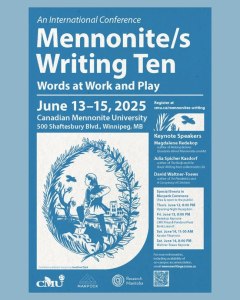
- Nevertheless, I can state the facts: this was # 10 in a series of conferences called Mennonite/s Writing, held every 3 years or so, and this time at Canadian Mennonite University in Winnipeg, Manitoba, June 13-15, under the theme “Words at Work and Play.”
- The conference happened against the news of nearly 300 dead in an Air India crash, Israel attacking Iran, ongoing National Guard/ICE craziness in Los Angeles, yet here we were, maybe 110 (?) of us, thinking and talking about writing, for in her keynote, Julia Spicher Kasdorf said her response to global concerns is to become more local, and these days, this was our local.
- I really enjoyed the conference — the sessions and keynotes of course, but also the collegiality, the many conversations with old and new friends, a happy sense of belonging because even though I don’t label myself a “Mennonite writer” (what does that actually mean, never mind these regular gatherings trying to figure it out) I still know that in some real way this is my tribe and besides, they’ll have me, which is always a happy and satisfying thing.
- The keynotes were highlights: Magdalene Redekop in an almost poetical trail of insights and juxtapositions on “translation” — a task we all take up in our lives — and David Waltner-Toews tackling “the meaning of everything” via science, that is, each of us “an unstable patchwork at our very core” yet interconnected, and Julia Spicher Kasdorf ruminating on Mennonite identity, noting “identity politics reduces complexity” and “identity work can wear a body out” yet calling us — stirringly — to commit to writing as practice and conversation.
- I very rarely — honestly — notice what people are wearing, though there were several memorable, if minor, exceptions this time, for I glimpsed a well-known writer in his pyjamas in the residence hallway and I think they were blue and white, and Di Brandt wore a garland of (cloth?) red flowers and leaves on her head during her presentation, and my longtime friend Sarah Klassen looked classy in a neat, belted teal dress, but I do notice space and felt the conference metaphorically balanced by having parts in the aged, wood-toned ambience of the Great Hall and its connecting corridors and other parts in the newish light-filled Marpeck Commons.
- Most of the sessions ran concurrently with others, which meant that every choice meant missing something else, but the personal program I selected began wonderfully with David Elias on his grandfather’s brother and Elsie K. Neufeld on her work as a personal historian and Linda Umble on reading Mennonite texts, and ended as wonderfully Sunday morning with three poets — Jeff Gundy, Julia Spicher Kasdorf, Ann Hostetler — reading their work, and in between I presented too (“Thinking about Oneself: Desire and Discovery in the Personal Essay and Memoir”) alongside Mary Ann Loewen who gave a memoir talk about herself and her granddaughter, both of which went well, we thought, and provoked some good discussion..
- A good number of younger people attended, and some presented, as in a session I attended featuring readings by Joelle Kidd, James Bergman, and Geoff Martin (whom I had “met” before, in a manner of speaking, when essays we’d written sat side-by-side in The New Quarterly — his was the winning one!) and it was great to hear new and younger voices in the mix.
- On the Thursday evening before the conference began, In Search of a Mennonite Imagination, edited by Robert Zacharias, containing key texts in Mennonite literary criticism, was launched at McNally Robinson Booksellers and I bought it, all 700+ significant pages of it, and later some other books besides, not as many as I may have wished but more than I could carry in my full backpack, but then a friend who lives in the next town over kindly offered to transport some of them, including the massive tome, in his luggage.
- The conference included an optional “literary tour” of Steinbach, which I selected to do, and it was interesting to see places associated with writers such as Miriam Toews and Patrick Friesen and ended with a delicious faspa at the Mennonite museum, where my final “Mennonite” sight of the weekend was a sculpture of the famous Dirk Willems story, which makes me wonder — in terms of two words Julia Spicher Kasdorf set against each other — whether it represented, and could be told, as “continuity” rather than “rupture.”


 Borrowing Bones