The mysterious Irene P., etc.

Earlier this month, I was a panelist at a Delta Literary Arts Society (DLAS) event here in Tsawwassen, with writers Raoul Fernandez, Debra Purdy Kong, and S.J. Kootz. Along with an honorarium, each of us was gifted a book from “the abandoned library” of a woman known as Irene P.; mine was Bird by Bird by Anne Lamott. “Do books long for a new owner?” asks a note pasted into the flyleaf. Assuming they do, “Just such a case has brought this book to you… once one of thousands in a collection owned by one Irene P.”

I asked the event organizer about her. She didn’t know much beyond the fact that when the woman’s house sold, there were thousands (6000, did she say?) books left behind, and hundreds about writing which somehow came to the DLAS and are used as unique thank yous. With all that advice on her shelves, did Irene P. write? I don’t know that either; hers is a story still to be told perhaps, but at any rate, I now have her 1995 edition of the Lamott classic, and it gives me pleasure. Since I already own the book, I’ll pass my copy on to someone else. And I think I’ll see if I can’t get more information about our mysterious donor.

*

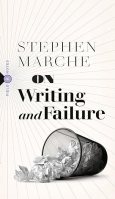
Speaking of writing advice, I recently read a small (80 pages) book by Stephen Marche called On Writing and Failure. Marche is no slouch, he’s written books and essays for all kinds of prestigious magazines, but he’s honest about the reality of the life: rejection. He kept track of them, he says, until they reached 2000, and hardly notices any more. He offers examples from other writers, and the point of it is not the promise of some inevitable arc to success, but his subtitle: On the Peculiar Perseverance Required to Endure the Life of a Writer. The book is full of quotable quotes:

English has provided a precise term of art to describe the writerly condition: Submission. Writers live in a state of submission. Submission means rejection. Rejection is the condition of the practice of submission, which is the practice of writing.

In an environment where some 300,000 books are printed yearly in the U.S. alone, and only a few hundred of those are what could be called creative or financial successes, there’s certainly no urgency for anyone to join the ranks. But if one’s there already, nothing for it, he says,81l-0zGg3GL._SY522_ but to keep at it, to keep submitting the work. “No whining,” he insists repeatedly. “The desire to make meaning…is a valid desire despite the inevitability of defeat.”
*

And, speaking of small but profound books, Sue Sorensen’s new poetry book, Acutely Life (At Bay Press), is an absolute delight. Whether she’s considering Freud or a musician or art or gardening/marriage or Mary the mother of Jesus, Sorensen registers on the page with both brilliant wit and deep emotional insight. Somewhere I read (though I can’t find the exact quote), one doesn’t interpret poetry as much as experience it. That’s how it’s been reading this book. I intend to read/experience it again.AcutleyLifeCover_(1)_800_1257_90

“Are you writing?”

I am frequently asked, “Are you writing?” or a variation of, “What are you writing these days?” The answer is that I haven’t been doing much new writing the past year, except for one essay about Helmut’s death. I have had, however, two projects to focus on, which have given me a sense of schedule and purpose throughout the year, in the gathering, editing, and proofreading functions of writing.

One of these is Return Stroke: essays & memoir, to be published by CMU Press and released in early June. I’m still shaking my head at the surprise of this all. Sue Sorensen, my CMU Press editor for This Hidden Thing (2010), had returned as head of the Press and since we’ve kept in touch, I tossed her an inquiry about a book of nonfiction. Back in 2015 I got a Manitoba Arts Council grant to draft a memoir about our two-and-half years in Paraguay, the most interesting place I’ve lived. I did it, as proposed and promised, but nothing further happened with it. Now I wondered about revising and reducing it, then combining it with some previously published essays as well as other pieces in my files, including the new one on Helmut’s death. Before I quite grasped what was happening, I had a manuscript to her and it was accepted! I’m rather glad, actually, that it unfolded somewhat impulsively, because a book centred in my life feels decidedly more vulnerable than fiction.

I’ll let the Press talk about the book, below. Pre-order information is here. It will also be available through McNally Robinson Booksellers, where I’ll do a Winnipeg launch June 2. I have a local (Delta) event planned for June 9, and one in Abbotsford, date TBA. Thank you for sharing my gratitude–and wee bit of nervousness–about this new book.968A4166-49E0-4164-8018-07571BB46EAD_1_201_a

This is the CMU Press description of the book:

These graceful, probing personal essays by award-winning fiction writer Dora Dueck engage with a diverse range of ideas (becoming a writer, motherhood, mortality, the ethics of biography, a child’s coming-out) because in non-fiction, she writes, “the quest for meaning bows to the experience as it was.” Yet within Return Stroke, one theme in particular does resonate—change. “How wonderful,” the author writes, that our “bits of existence, no matter how ordinary, are available for further consideration—seeing patterns, facing into inevitable death, enjoying the playful circularity of then and now.”

The book’s title, Return Strokethe title of one essay, where it literally refers to lightning—suggests such a dynamic: “When I send inquiry into my past, it sends something back to me.” The topic of memory, in all its malleability, impermanence, and surprising power, is especially central to the collection’s concluding piece, an absorbing memoir of the author’s 1980s life in the Paraguayan Chaco. Whether she is discovering the more meaningful part that imagination holds within her religious faith or relating with astonishing clarity and honesty the experience of giving birth away from her home country, Dora Dueck’s beautifully written essays and memoir make her an insightful and generous companion.

Short stories, take a bow

May is short story month. I have no idea who decides matters like this, but why not? Short stories, please take a bow, and let me say a few things in your favor. — One often hears that people prefer reading novels, that short story collections don’t sell, that publishers therefore hesitate to take the risk. All this may be true. In a novel, we enter for the long, deep involvement and we feel the reward of hours invested. Each story in a collection, on the other hand, takes new effort to discover what’s going on and who’s in it. Perhaps it feels like a fragment rather than a whole, perhaps it feels unresolved. Still, a good short story can carry weight out of proportion to its size. Continue reading