Two things I don’t do often: write a blog post just a week and some days after the previous, and go to the same movie twice. I’m doing the first because I was so deeply affected by seeing “Women Talking” I went two days in a row. The first time, I attended alone, and the second, with four friends and then out to dinner to discuss it. Both times were powerful.
This isn’t a typical review, so if you’re not familiar with the details of the film, there are many reviews (like the Guardian’s) and responses online that supply them. Nor is it about the plight of the women in the story behind the story or how consistent or compatible to “real” Mennonite life it is or a critique of casting or screenplay or anything else. These were discussions that happened in my Facebook feed before I attended, and they interested me because years ago I engaged myself with the Bolivian Mennonite women’s story and also read and reviewed Miriam Toews’ novel Women Talking, but after seeing the movie I found myself strangely disinterested in opining on any of this, for the movie affected me at a visceral, not intellectual, level, and that’s still the place it sits. I can’t quite articulate why or what about this version of the story called up such emotion in me. My friends and I certainly remembered situations of it not mattering what we thought but mine has been a place of privilege in terms of the horrific backstory here. Still, somehow I felt myself within every woman in that hayloft, as well as those like Scarface Janz who left the conversation. I did love the two older women in particular, yes, but I “knew” the women of the other ages too as the camera lingered on their faces.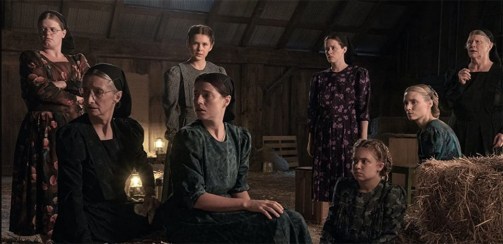
But I’m not sure that’s quite it either, it sounds preposterous to suggest that I understand each angle or position within the arguments, reactions, consolations, and even laughter about forgiveness and innocence and courage. About the wisdom in “it is possible to leave…in one frame of mind and arrive elsewhere in another entirely unexpected frame of mind” (August). About what to do!
Please forgive the foggy imprecision of this response. Maybe it was simply being drawn into a story that feels core in its concerns, about topics important to all of us. And for sure to women. Maybe it’s because if I wrote the minutes of my life I would set down exactly their desires too: that we want our children to be safe, that we want to be steadfast in our faith, that we want to think.
 Becoming (2018) by Michelle Obama. I don’t know if it’s the trajectory of her life from Chicago’s South Side to the White House or her honest and passionate way of speaking or the brave self-awareness that opens towards growth – to “becoming” – or the current political situation which feels so different, or all of the above, but I was deeply moved by this book. To the point of tears at times. Moved and inspired to keep on becoming myself and making the world better where I can.
 Motherhood (2018) by Sheila Heti. Like some reviewers, I found this Giller-shortlisted “autofiction” odd and self-indulgent at first. It doesn’t have much of a plot; the narrator records, from this angle and that, her struggle whether to have a child. But, like the even more obsessive Karl Ove Knausgaard’s work, it was strangely compelling (though I refuse to give Knausgaard more than one book’s worth of space in my head) so I persevered and was rewarded in the end with intense probing of an important question, regardless of what decision is made, and then both movement and readerly satisfaction as the theme faces the narrator’s own mother. Perhaps this read also lingers with me because Heti uses the Genesis story of Jacob wrestling with the angel and I happened to be reading, at the same time, The Angel of the Left Bank by Jean-Paul Kauffman about the Delacroix painting “Jacob Wrestling with the Angel” in Paris. Both books reminded me that what we wrestle with changes us, humbles us like a limp.
 The Redemption of Galen Pike (2014) by Carys Davies. These are wonderful stories, quite short, and successful at a quality Susan Sontag described this way: “Every fictional plot contains hints and traces of the stories it has excluded or resisted in order to assume its present shape. Alternatives to the plot ought to be felt up to the last moment.” Suspense, in other words, of the very best kind. And though the point of stories is not the extraction of moralisms such as “appearances are deceiving”, I think that we do in fact read to remember that there’s often more at play than we suppose or see. Davies’ recent novel West is also good, also short (on some reading days that’s a huge virtue), but if you want to sample Davies I suggest beginning with the stories.
 Blindness. This 1995 novel by Portuguese novelist and Nobel winner Jose Saramago grips as narrative, and also by its various possibilities as parable, including these lines about a blind writer’s words in ballpoint,“inscribed on the whiteness of the page, recorded in blindness, I am only passing through, the writer had said, and these were the signs he had left in passing.” Then, since I was immersed in this during our spring visit to family in Paraguay (I never travel without a book), an awful juxtaposition of text and life: our niece, a young grandmother, was led to us at a gathering, recently and mysteriously become blind. (Last we’ve heard, surgery didn’t work and she hasn’t yet recovered her sight).
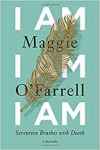 I am, I am, I am: Seventeen Brushes with Death (2018) by Maggie O’Farrell. That’s a lot of close calls. One of them made my skin crawl. But in their sum this memoir provokes gratitude for the mystery of life – hers, and mine – and compassion. Plus she’s a very good writer.
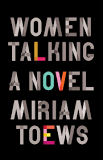 But I don’t think any of us ever thought it was enough. When I heard, last spring, that Miriam Toews had written a book reacting to these events, I was excited — excited to read her “take” on it since I greatly admire her writing, and excited that her status as an internationally recognized author might bring wider attention — dare I say further prayer, lament, perhaps even solace? — to the women.
 Borrowing Bones