 Since my work as interim editor is drawing to a close next week, I thought I might offer a few further blog-ruminations about it as I wind down.
It’s been a surprise, sometimes, what people react to. (I mean the reactions, of course, that reach our office.) There was one article, for example, we carried this year that felt good but also a little risky to me — in its potential to be misunderstood — but nary a discouraging word. In fact, the author told me that it had provoked some excellent further conversation that was all very interesting and positive.
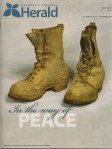
But our last issue — November’s — which focussed especially on the practice of peacemaking this time (as the well-“practiced” boots of a World War II conscientious objector suggest on the cover, above), and whose articles and stories seemed straightforwardly good in their implications, not provocative… I guess there must be something about peace that loosens them fightin’ words even among nonresistant Anabaptists. We’ve had some affirming responses, yes, but a couple of letters I hadn’t expected too — with reactions such as “profoundly saddened” and finding the issue “extremely one-sided,” and then further to this bit or that, “frustrating — and faintly insulting” and “particularly troubling.” These were private letters, so won’t be published, and the details don’t matter; plus I’ve had a good exchange with both letter writers already. We love to get letters, both personal and for our Letters to the Editor column, but like I said, reactions can be a surprise.
One realizes again that the article one thinks one’s written, or the magazine one thinks one has put out, is never quite the same as the article or the magazine read by this reader, or that one. — This reality certainly keeps things interesting though.

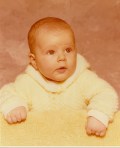 But “mother” is a role/name/fact that’s a huge part of my life, and today I’m celebrating the day it began. It all started 33 years ago today when the little fellow, pictured left at 3 months, was born. (He gave permission to post the photo.) I don’t think you can ever imagine at the time what it will be like to be bound up with another person for the long haul the way a mother is, but you discover it — through joy and difficulties — as you go, and I can say this for sure, the child who started it and his two siblings who followed (whose baby photos I will post on their own birthdays, if they let me) have definitely, definitely been worth it all. (Especially now that I’m off-duty.)
 Borrowing Bones