 Dear Evelyn opens with a birth — of Harry Miles, who is half the couple featured in the book. I’d just read some wonderfully feisty comments by the late Margaret Laurence about birth scenes in novels, so was immediately positively predisposed to this novel by Kathy Page, which dared such a scene right out of the gate. (A male reviewer of Laurence’s first novel, This Side Jordan, had wondered about “the obligatory birth scene in novels written by women,” which infuriated Laurence, though the good thing was, “that dolt” launched “a kind of self-liberation” for her in writing. Fine for men to write endlessly of violence or masturbation or sexual conquest, she said, but “not at all right, apparently, for a women to speak of the miraculous beginnings of human life.” After that, she never hesitated to write about birth, “from the viewpoint of the mother.”*)
And then, I happened to read Tess Hadley in a Guardian interview saying she wanted to write about long marriages (as apparently she does in her latest book, Late in the Day), because “they seem immensely interesting and they are kind of new in a way … people just live so much longer,” and I thought, well I certainly like to read about long marriages, being — at 44 years and counting — well on the way into a long marriage myself, and there I was, happily into Dear Evelyn too, which is exactly on the topic.
It’s not that Page’s novel needs these asides from Laurence or Hadley to bulk its worth, but I mention them by way of noting how often it’s the entire atmosphere of reading — current circumstances, personal life stage, other voices bumping alongside — that makes a particular book memorable. At any rate, with or without all that, Dear Evelyn is a fine and memorable book. Page skilfully unfolds the characters and experiences of Harry Miles and Evelyn Hill — from his birth to her death — in linked short stories. Each chapter/story treats of a specific episode or slice of their separate or joint lives, but the sum of them feels seamless, as if everything in between has been revealed to us as well.
Harry and Evelyn meet outside a library, and he is taken not only with her beauty but her strong sense of striving. “A girl like her would need him to be ambitious, more so than he had been so far. Even as he realized this, he committed to it.” We already know that poetry grabbed hold of Harry’s head and heart under the tutelage of his teacher Mr. Whitehorse, and at this early point it’s easy enough to assume that his “ear for verse” and nascent interest will grow and be fulfilled. But that’s the thing about life and marriage — they limit, even thwart. Which is why Harry and Evelyn as couple is a story of love but far from a happily-ever-after one. Their ambitions, so compatible at one level, compete drastically at another, not to mention the changing and powerful shaping circumstances of war (and the separation and temptations it imposed), children, and old age.
A week after finishing the book I’m still thinking about this fictional relationship. Does one admire, or pity? Can fault, realistically speaking, be laid? The 2018 Rogers Writers’ Trust Fiction Prize jury, which awarded Dear Evelyn the win, called the novel “tender and unsettling.” Yes. Both those words.
*Margaret Laurence, Dance on the Earth
 Becoming (2018) by Michelle Obama. I don’t know if it’s the trajectory of her life from Chicago’s South Side to the White House or her honest and passionate way of speaking or the brave self-awareness that opens towards growth – to “becoming” – or the current political situation which feels so different, or all of the above, but I was deeply moved by this book. To the point of tears at times. Moved and inspired to keep on becoming myself and making the world better where I can.
 Motherhood (2018) by Sheila Heti. Like some reviewers, I found this Giller-shortlisted “autofiction” odd and self-indulgent at first. It doesn’t have much of a plot; the narrator records, from this angle and that, her struggle whether to have a child. But, like the even more obsessive Karl Ove Knausgaard’s work, it was strangely compelling (though I refuse to give Knausgaard more than one book’s worth of space in my head) so I persevered and was rewarded in the end with intense probing of an important question, regardless of what decision is made, and then both movement and readerly satisfaction as the theme faces the narrator’s own mother. Perhaps this read also lingers with me because Heti uses the Genesis story of Jacob wrestling with the angel and I happened to be reading, at the same time, The Angel of the Left Bank by Jean-Paul Kauffman about the Delacroix painting “Jacob Wrestling with the Angel” in Paris. Both books reminded me that what we wrestle with changes us, humbles us like a limp.
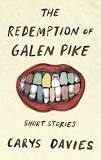 The Redemption of Galen Pike (2014) by Carys Davies. These are wonderful stories, quite short, and successful at a quality Susan Sontag described this way: “Every fictional plot contains hints and traces of the stories it has excluded or resisted in order to assume its present shape. Alternatives to the plot ought to be felt up to the last moment.” Suspense, in other words, of the very best kind. And though the point of stories is not the extraction of moralisms such as “appearances are deceiving”, I think that we do in fact read to remember that there’s often more at play than we suppose or see. Davies’ recent novel West is also good, also short (on some reading days that’s a huge virtue), but if you want to sample Davies I suggest beginning with the stories.
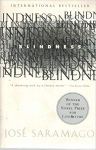 Blindness. This 1995 novel by Portuguese novelist and Nobel winner Jose Saramago grips as narrative, and also by its various possibilities as parable, including these lines about a blind writer’s words in ballpoint,“inscribed on the whiteness of the page, recorded in blindness, I am only passing through, the writer had said, and these were the signs he had left in passing.” Then, since I was immersed in this during our spring visit to family in Paraguay (I never travel without a book), an awful juxtaposition of text and life: our niece, a young grandmother, was led to us at a gathering, recently and mysteriously become blind. (Last we’ve heard, surgery didn’t work and she hasn’t yet recovered her sight).
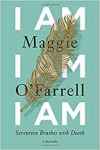 I am, I am, I am: Seventeen Brushes with Death (2018) by Maggie O’Farrell. That’s a lot of close calls. One of them made my skin crawl. But in their sum this memoir provokes gratitude for the mystery of life – hers, and mine – and compassion. Plus she’s a very good writer.
