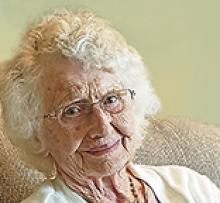
Susie Harder Loewen
My mother’s youngest sister died this week, at 91. So I’ve been thinking about her, my Aunt Susie, and gratitude swells as the memories gather. Her qualities of competence and hospitality and commitment to family. Memories of being junior bridesmaid at her wedding (though I mostly remember my dress), her hosting the gift-opening after my own wedding, and her house — of course — being the place we could drop our first child while rushing to the hospital for the birth of the second. It was Aunt Susie, not Mom, who taught me to sew, and I remember that week with them in their Winnipeg house, how patient and wise she was with her little girls. There was a sense of welcome about her, and as far as I was concerned, every expectation that the welcome should be there. Taking it for granted, I suppose. She was my aunt, after all.
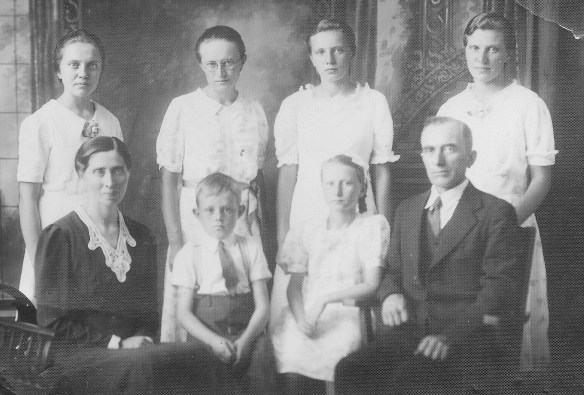
Harder family (late 1930s?). My mother, Tina, standing far right; Aunt Susie seated beside their father.
She’s the last of them on my mother’s side — the last of The Aunts, I mean, a category all its own. (Mom, 98, the only one of her family still alive.) My mother had four sisters, thus we had the four aunts. As we got older and had families of our own, my siblings and I sometimes discussed and compared them, for The Aunts — the Harder aunts — seemed formidable women, strong was the word, and each in her own way, opinionated too.
I’ve noticed the role of aunts in fiction. Their usefulness as foil, as rescue. Just recently, for example, I read Kate Atkinson’s Life After Life, with its unconventional Aunt Izzy as contrast to Ursula’s traditional mother Sylvie. And in real life too — and I’m speaking generally here — aunts fill gaps mothers may not fill, provide near-hand models of other personalities to watch, perhaps emulate. Their faults become instructive as well, perhaps arouse appreciation for the mother one landed to. They belong to us, that’s the thing, they’re our heritage, but by virtue of connection plus difference, enlarge that heritage. Sharpen or soften it. Round it out. Sometimes, if they’re single professional women, they may tip a bit of money our way, which when we’re young and beginning, feels enormous. If we’re fortunate, they root for us, encourage, offer advice sought or unsought, in other words, freely help themselves to our lives, as we to theirs, and as a bonus, are interested in and involved with our children, and all this with less thanks in return than they deserve. Blessed be The Aunts!
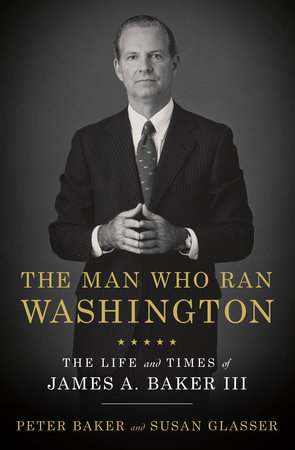 I’ve just finished The Man Who Ran Washington, a biography of James A. Baker III, who served four presidents (Ford, Reagan, the two Bushes) in a variety of capacities, most notably as Chief of Staff and later Secretary of State. Authored by Peter Baker (no relation) and Susan Glasser, it’s a thorough and eminently readable book. I admired Baker as I read, though I can’t say I entirely liked him. But never mind that; what I especially enjoyed here was how a biography like this takes me back into events that are “history” already but happened in my lifetime and, thus, can be remembered, into consequential events that affected me too (and I recorded in my journal), if only because of the collective mood or tension they created. (Sort of like now, the day before the U.S. election. Sort of like now, months into a global pandemic.)