Tuesday, October 1. Regina, Saskatchewan
After two days of driving we’ve arrived in Regina for the night. Monday, the highway through the mountains was clear in spite of the weekend storm — “historic” for September — that swept into southwestern Alberta, and we travelled well. After Golden, where the Rockies are especially large and majestic, the snow had given them an austere and hoary look and the pine forests were snow-iced too; it seemed Christmasy. I’d anticipated, ever since planning this trip, our happy emergence out of the mountains into the foothills, and there it was, the broad rolling terrain and the big sky, but I’d not anticipated winter upon it. Not now! Autumn yellow trees poking out of snow just looked odd.
 We had supper and stayed the night with my brother John and wife Barb at their acreage in Water Valley. Their house backs onto pines, and these too were beautifully hung with snow, and being in the country it was a very dark and quiet night. John had a wood fire going while we caught up on our respective lives and health and families and also reminisced about some incidents during our childhood in Linden. He recalled how he and other boys ran down the hill into the valley to see the horrible accident that befell two men working on storm sewer installation, when the earth caved in and buried them. For him, the watching of efforts to dig them out, remains a vivid memory, but I think of the families to whom these men belonged (strangers to the community). That day must have been world-changing for them.
Today — Tuesday — we drove in white for some hours, eastward through Alberta, the sky white, the earth white, and for some time into fog as well, but eventually the aspect of the earth changed and by the time we reached Moose Jaw, it was all the expected prairie autumn tones of early October, and that prairie sky loaded with clouds in a great variety of blue and grey, and the feeling I was feeling was familiarity and it was a very good feeling indeed.
I’ve been reading, when it’s not my turn at the wheel, The Art of Leaving by Ayelet Tsabari. It’s a memoir in essays by an Israeli woman of Yemeni background who leaves her home in Tel Aviv for travel and work in a great many places, and for a great many relationships, undone it seems by the death of her beloved father when she was a girl. “[L]eaving is the only thing I know how to do,” she says at one point, “…the ritual of packing up, throwing out or giving away the little I have, packing and taking off.” Tsabari is an excellent writer, but I’m showing my age I suppose if I say that I’m reading her restlessness with a kind of impatient ache on her behalf. But I’ve got half the book to go and lots can happen yet.
Saturday night, before the trip, I stayed up late to finish Michael Crummey’s Sweetland. I know, I know, it’s not his most recent, shortlisted for the Giller, but it’s the one I was reading. And it’s very good, and I had to think, in comparison to Tsabari’s experience, that novel could be subtitled “the art of staying.” The character Sweetland, who’s always lived on the small island off Newfoundland with the same name as his, except for a brief foray for work in Toronto, stubbornly resists the government’s wish to re-locate him to the mainland, along with the island’s other remaining residents. I’m fascinated by the idea of living in the same place all one’s life, which I myself will never experience. But I know some who have and I should probe this with them.
Off and on I keep thinking too about the recent death of Andris Taskans, founder and long-time editor of Prairie Fire. The arts community of Winnipeg is in shock and grief. He was such a vital part of it. I claim no close friendship with Andris, though we knew one another, but I felt his encouragement and support for he published a number of my stories over the years, and I sensed his kindly character in our various encounters.
Well, nearly done this ramble, diary dear, but what a surprise when we were “seeking” for CBC in Saskatchewan and the very first thing we heard when we found it was the name “Dave Schwab” and sure enough, the Dave Schwab we know, describing his harrowing encounter with a bear.
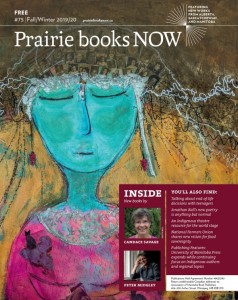 Mid-afternoon I learned that All That Belongs is featured on the cover of the current issue of Prairie Books Now and that a review of the book had appeared in the Winnipeg Free Press today. Both were lovely surprises. I haven’t seen the PBN article yet or read the review but my sources told me it was good, which was enough to get me through the evening without worrying about it. Some writers don’t read reviews, either good or critical ones. I’ll read this one eventually, but today was not the day. I needed to focus on the evening event.

