Konstantin Paustovsky & Hildi Froese Tiessen: there, then

I’ve been working my way through Konstantin Paustovsky’s 6-book Story of a Life this month. I heard about Paustovsky on The Mookse and the Gripes podcast and was drawn to his work when I discovered he was an almost-exact contemporary of my grandfather, about whom I’ve been thinking on account of last fall’s trip to the Caucasus. My grandfather was born in Molotschna Colony, Ukraine (then Russia) in 1890 and Paustovsky was born in Kiev, Ukraine in 1892.

I was also pleased to discover that the entire series is held at the Vancouver Public Library. I took them all out.

Since I may — someday — do a personal essay about my grandfather in the Caucasus during WWI, reading Paustovsky is a kind of research, though of the most pleasurable variety, for he writes vividly, not at a distance but from within each experience as it occurred. During the war he worked on a medical train, as did my grandfather. He was in Moscow during the early revolutionary period, when the city was “one solid, seething, endless public meeting.” He was in Kiev during part of the 3-year period when Ukraine underwent civil war and 17 political upheavals.

The first three books were especially compelling, but I will persist to the end because after a year in Odessa during the blockade (Vol. 4), Paustovsky spends time in the Caucasus in Vol. 5, which I’ve reached too. I look forward to his descriptions of that region.

Mennonite/s writing

I’ve also worked my way this month through On Mennonite/s Writing, selected essays by Hildi Froese Tiessen — “a scholar widely recognized as the primary critical figure in contemporary Mennonite literary studies” — recently published by CMU Press. The selecting of 18 essays, from her more than 80 contributions in the form of essays, book chapters, special journal issues, and so on–was done by Robert Zacharias. He also provides a fine introduction to Froese Tiessen’s overall work and this collection.

This is an important book, both in terms of honouring Froese Tiessen and of encapsulating a history of critical engagement with Mennonite literature. It was also fun to read.

I think I may have read some of the essays before, and certainly had some sense of the emergence of a so-called Mennonite literature, but I enjoyed starting at the beginning with her first essay in 1973 about Rudy Wiebe’s work, and seeing, in real time as it were, her continuing and developing insights into what was going on, especially in the relationship of Mennonite writers and their Mennonite community.

I read this book as a reader of Mennonite literature — and do recommend it to other readers and to students of literature — but I also enjoyed it as one of those “writers who happens to be Mennonite,” whose work came along rather later, in the wake of the period she especially observes. Reader or writer, we will all likely share the question of what comes next, and may have our opinions about what should or could, for as Froese Tiessen makes clear, the field has changed and continues to change. Her last essay describes the shift as one of “Mennonites as a community written about” to “Mennonites as a community writing.”

Two asides, or additional points of interest for me. The essay on the “forever summer, forever Sunday” trope of the Mennonite past in Russia, which entered the work of Rudy Wiebe, Sarah Klassen, David Waltner-Toews, and Sandra Birdsell (“Between Memory and Longing”) struck me as almost ironical as Froese Tiessen discerns/articulates an effect she herself could be said to have created. (She and her husband published a book of Peter Gerhard Rempel’s photographs of Mennonites in Russia with that title.) Perhaps an element of such circularity also characterizes her wider contribution to the field.

And then, in the middle of the book, in the essay “The Case of Dallas Wiebe,” three poems! His voice “distinctive enough to unsettle or inspire,” she says quite rightly. From the poem “God Speaks to the Geriatric Convention,” lines that sprung out to me:

You should imagine
that when you walk
through the valley of the shadow of death
that I am the one
who casts the shadow.

Reflecting on her life’s work, Froese Tiessen says, “[D]uring that irruption of Mennonite writing concentrated in the last two decades of the last century I had found myself, so often, right there, right then.” We can be grateful she was there, then, for her thinking is astute, her writing is clear and accessible, and her impact was enormous.

December’s great big decision

This week — between Christmas and New Year’s and a few days beyond – can be anticlimactic after packed and people-full holiday events, can even be, as someone on Twitter once remarked, “strange and timeless and heavy with depression and restlessness,” but that’s not the case for me this year. On the contrary, it seems among the loveliest of weeks. There’s a sense of fulfilment in what’s just happened and no particular obligation left, while the tree twinkles still with its lights and special ornaments, the poinsettia carries on with its remarkably radiant red, and there are leftovers to eat. Even for someone who’s semi-retired, there’s an impression of extra permission in the air: do what you want.

This airiness, this possibility, threads me back to such weeks in my childhood, when the main events of Christmas were done but we had more days free of school and did a puzzle, played games, read for hours, skated. Oh how we skated! Round and round and round the rink, in the bliss of the crisp outdoors and the ecstatic glide of blades on ice.

This week I have a puzzle spread out, and enough to read. I’m thinking about the past and the future. Not exactly making resolutions but assessing. Playing with images of Spirit. (“I take refuge in the shadow of your wings” Ps.57:1) Considering the multiple conflicts and sadnesses in the world.

IMG_3770

And then there’s December’s great big decision (don’t laugh): next year’s journal. I’ve done large notebooks, Moleskines and knockoffs, in-between sizes. I’m fussy by now: the paper has to be quality so it doesn’t bleed through with ink on both sides, it has to be narrowly lined. (I’ve also tried unlined.)

I liked this year’s journal book, but can’t find another like it. I have something close though am wary of the coil binding going wonky on me.

At the juncture of a new notebook, I brood about my journaling practice too. Should I go for diary-like, or intermittent random thoughts? How about one of those one-line-a-day attempts? Sounds like a fun challenge but might be like handcuffs for a writer. Gratitude and grump, or just gratitude?

In In The Jaws of the Black Dogs, John Bentley Mays judged his Aunt Candalia’s diaries as “performances of dread, a stalling of death… an attempt to ground herself, if on no more solid ground than the shifting site of writing….”

Mays’ critique stings, for yes, the journals/diaries certainly add up to “the suffocating intimacy of details” over the years, but then again, if I hadn’t noted these quotes when reading his book back in 2007, could I have used them here? At any rate, the new year approaches and I’ve got an (almost decided upon) notebook waiting as pristine and empty as a field of new snow, ready for the first foot marks of the first day to be written over it.

IMG_3768

I wish you all a good new year, friends, however you live and mark your field of days. May you be blessed!

Eating at IKEA and Eating Like a Mennonite

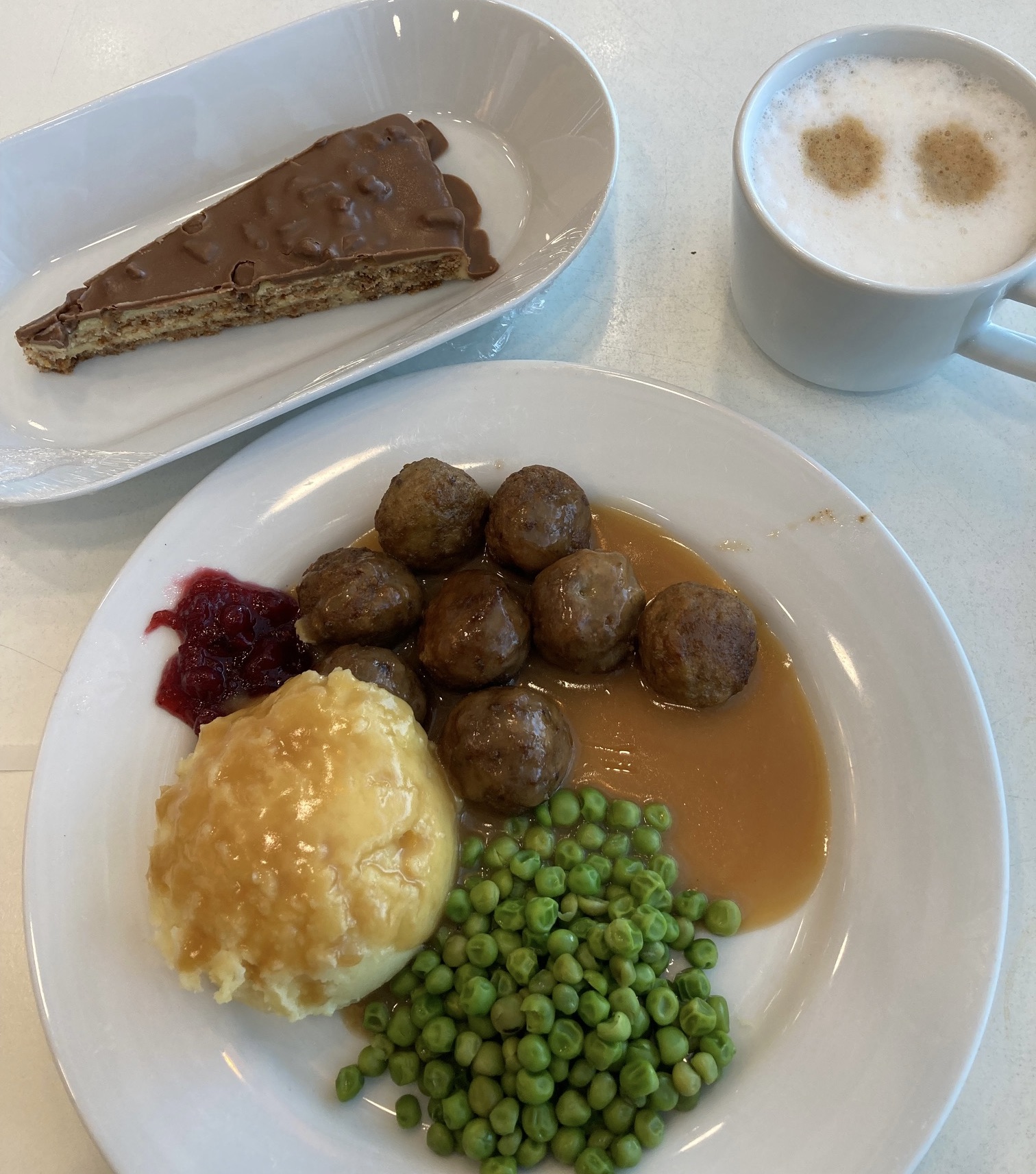
I stopped at IKEA for a few things recently and since it was close to noon, had lunch in their dining room. As usual, I had the Swedish-meatballs-mashed-potatoes-vegetables-and-dab-of- lingonberries plate and a triangle of DAIM cake for dessert.

IMG_3702

As usual, I say, because this is the very thing Helmut and I ate on our numerous trips to IKEA after re-locating to B.C., when we needed bookshelves, and then more bookshelves, and end tables, and so on and on. Although we brought some furniture along, we had left a good deal behind as well, and now we re-furnished as if we were students starting out — as cheaply and easily as possible! 

So I have good memories of those meals and if I happen to eat at IKEA now, I find myself making the same selection as before. It’s tasty enough, though IKEA-mass-produced, and I’m not sure what makes the meatballs Swedish, but it’s a meal of comfort for me on account of remembering those earlier times.

61SLqzKq6yL._SY522_

A few days later, I attended the launch in Abbotsford of Marlene Epp’s new book, Eating Like a Mennonite: Food and Community across Borders. Marlene Epp is professor emeritus of history at Conrad Grebel University in Waterloo, Ont. and well-known for her book, Women without Men: Mennonite Refugees of the Second World War (2000). She brings the same careful analysis, research, and skill with anecdotes to the topic of food: its role in identity, how what it “is” shifts through migration and encounters with other foodways (“hybridity”), how recipes are passed on, “the complex terrain of food and gender,” food trauma, and the place of food in religious practice. 

These topics play out in other groups as well, of course, but Epp’s focus is Mennonites (world-wide) and because I happen to be Mennonite, her book has been of great interest to me. As I read I couldn’t help inserting my experiences with food into her analysis. When she speaks of “the symbolic capacity of food to contain the past,” true for persons as well as communities, there was the recent repeat selection of a memory-laden meal at IKEA as an example. In fact, it is often food — his favourites or my making of Paraguayan chipa, which was his “specialty” and job — that evokes bittersweet recollections of him.

IMG_5562

Epp writes a fascinating chapter on cookbooks. She also addresses presumptions about Mennonite women as good cooks, as seen in the Mennonite Girls Can Cook blog phenomenon, for example. It was the MGCC phenomenon that prompted some writer friends of mine to propose, some years ago, an anthology around the idea that Mennonite Girls Can Write (about Food). Although the project didn’t happen, it inspired me to look at my life through the lens of food, written into something I called “Notes toward an autobiography,” though told in the third person, which landed in Return Stroke: essays & memoir. In that piece I had to start with the truth that though I admired and wished to emulate my mother, she was not a particularly good cook. (It occurs to me that because of that, I tried harder, even though I too am more dutiful than fond when it comes to meal preparation.) 

When I read a section about my experience with cookbooks at a launch of my book, I was surprised how much laughter it elicited. But it’s true, there’s often great seriousness about food, and there’s trauma in histories or presence of hunger, but looking back, laughter as well.

…She began with the cookbooks of her own tradition: The Mennonite Treasury of Recipes and The Mennonite Community Cookbook. She put eager comments in the margins when something turned out well: Aug.24/75 With our own apples! Yummy, and my first platz! Later she added, Also nice with rhubarb.

In time it annoyed her that most of the women who’d submitted the recipes identified themselves through their husbands — they were Mrs Jake Krahns, for instance, or Mrs Sam Detweilers — but well before that she was frustrated by their all-knowing vagueness. They left out baking times and other vital information. They said things like “enough flour for a firm dough.” What was a firm dough compared to a soft one?

Betty Crocker saved her. In Betty Crocker’s cookbook, no one cared about Mr Crocker’s name, or whether Betty was even married, or if she went to church. The language was English, the ingredients available in any regular store. The amounts were precise. Every single step was explained. The recipes succeeded. With Betty as her guide, she learned to make cream puffs, tall elegant cakes, pudding from scratch, strogonoff, and turkey pie. She hung on to that cookbook long after its cover had torn off and its pages were ruined with grease and gobs of batter. Long after her dependency on Betty Crocker had ended, she loved Betty’s book best.

Marlene Epp’s book would make a great selection for a book club, though the discussion of all the angles she pursues and their significant considerations around food might well devolve into an evening of personal stories (as has happened here in this post) and likely a fair bit of laughter. At any rate, I enjoyed Marlene’s book and recommend it.

sc009b2db3

But last of all this, who knew that watermelons were such a “marker” of food identity for Mennonites? And that there are various ways to cut them — neatly or for slurp effect? When we lived in Paraguay, where watermelons were plentiful in season, our young sons tackled theirs outside and with spoons!