Do I golf?

It’s high summer, the Gulf oil spill seems to be capped, so time for something lighter here… a bit of fun. Please note, dear friends and acquaintances, that the following is an amalgam of conversations/experiences over the years; no one should feel recently or personally incriminated! 🙂

It always begins as the most pleasant, the most innocent, of inquiries, asked with so much anticipation, as if the asker and I are about to be fast-tracked into understanding one another perfectly.

“Do you golf?”

I hesitate.

I could say, “Yes, isn’t it wonderful?” and then I’d be inside, I’d be a Someone Who’s Grasped the Good-life Secret.

But where would such subterfuge get me? Next thing I know, we’d be booking a game and the truth would have to come out.

Better to admit it.

“No. No, I don’t golf.”

Following this, disappointment or even pity may hang in the air. (I guess we won’t be tight after all.)

But sometimes the asker’s hopeful enthusiasm is simply re-directed. Attempts to ferret out my reasons and then overcome them begin in earnest. (Many golfers, I’ve noticed, tend to be zealous on the game’s behalf.) Continue reading

No grand tour

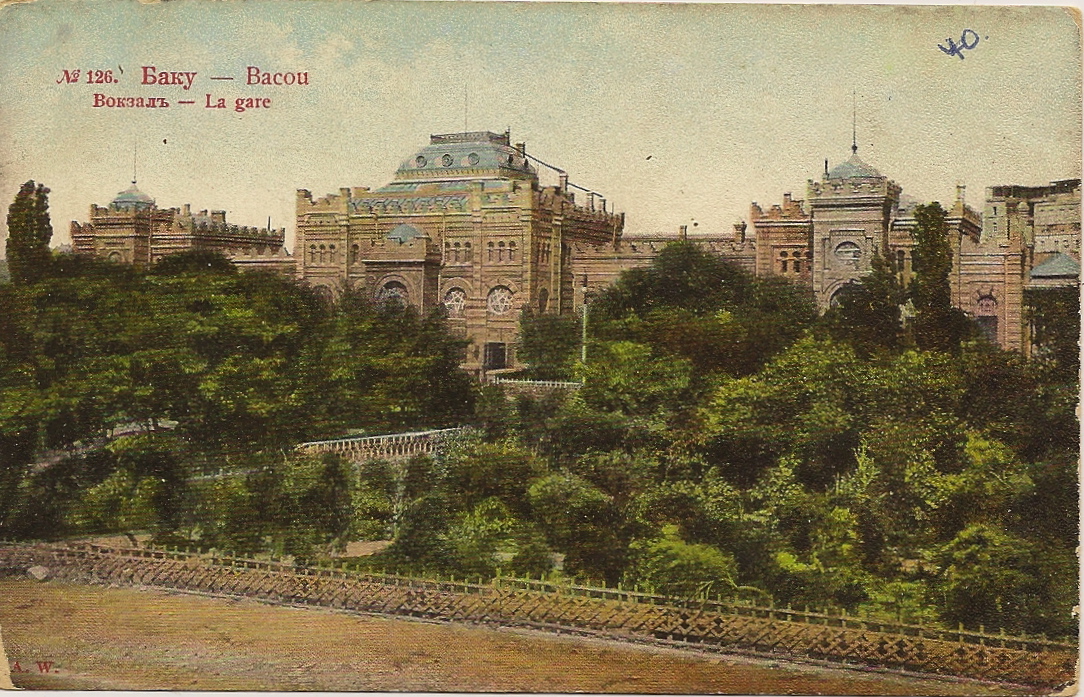
A new postcard slice as header: still Baku in Azerbaijan (on the Caspian Sea) because I want to maintain a connection, roundabout as it may be, to the current oil spill in the Gulf and the shared global sorrow of that.

(The connection is our love affair with oil. By the end of the 19th century, Baku’s fame as the “Black Gold Capital” had spread throughout the world. Between 1897 and 1907 the largest pipeline — 883 km. — at that time was built from Baku to Batum; Baku had more than 3000 wells by 1900. As I mentioned here, the Nobel brothers were the oil tycoons of the region.)

But Baku in colour this time, and a view of The Boulevard and the “baths” at the sea. (It’s not colour photography as such, but was a tinted photo, creating a charming if somewhat surreal effect.)

This is one of 10 cards of Baku in my grandfather’s postcard collection. (See other postcards from his album here and here.)

The Boulevard and baths at Baku

He served as a conscientious objector during World War I, in a provision the Mennonites had won with the Czarist government for non-combatant roles. He worked on the medical trains, transporting the wounded away from the front lines of Russia’s southern front in the Caucasus region. This service gave him an opportunity to see places he might never have seen otherwise. “Never did I dream that I would travel as much as I have done by now,” he said in one letter to his fiancee, Helena.

It sounds almost poignant to hear him continue:

After this time of rest will come a time of work… and when we have then worked for some ten years and God makes it possible for us, then we will travel abroad. The travel route is as follows: out through one of the harbours on the Black Sea, through the Dardenelles into the Mediterranean Sea, not forgetting about Greece and Italy, into the Atlantic Ocean to see the New World, and then on to England, Holland, Norway, Sweden and Germany, and back home to our peaceful home on the steppes of Russia. Are you satisfied with such a route?

Train station at Baku

Poignant because the Russian Revolution intruded into such dreams and it would be decades before the steppes of Russia could be said to be peaceful again. Under those conditions, the  grand “tour” never happened. Heinrich and Helena were fortunate enough to travel to the New World as refugees, where they settled on a farm in southern Manitoba.

“It seems to me that everything that happens to us is a disconcerting mix of choice and contingency,” Penelope Lively said. So for my grandparents, so for the people and creatures at the Gulf.

————–

Next week — Monday to Wednesday — I’ll be attending RIM (Renewing Identity and Mission), a consultation at Trinity Western University, consisting of some 30 presentations, taking place before the Mennonite Brethren Celebration 2010 event. I’m looking forward to it, and also to sharing bits of it later, here at Borrowing Bones.
 

Catch-up

The industrial bleakness of Baku’s Black City (above) depresses me slightly every time I come to this blog, because it reminds me of the still gushing oil spill… But Life Must On, as they say colloquially, and here it’s time to catch up.

When I first started “Borrowing Bones” last November, I commented that I don’t “use” my children in my writing much, because they have their own lives to interpret and describe, but — it being First Son’s birthday that day — I did post a baby photo of him and remarked how glad I am to be a mother. I also said that I would follow suit with the next two when their birthdays rolled around.

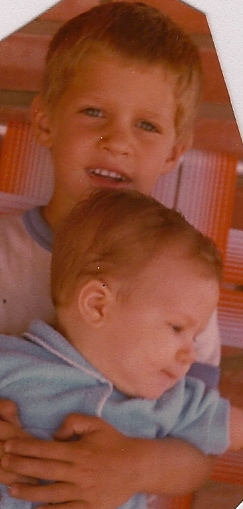
Daughter’s birthday falls at the end of May, and Second Son’s in the middle of June — so it’s more than high time to keep my promise. (Any parent knows you have to be fair to each child in turn, and you have to keep your promises.) So the little snapshot above is Daughter as a baby, held by her brother. Wow, they’re so cute — wish I could go back in time for a little cuddle with each of them.

And now? — Okay, just this once. Our oldest son is an engineer. He and his wife, who works as a doula and photographer (you can see her work on her blog under my “Family and Friends” list) have four children and live in Tsawwassen, B.C. Our second son just graduated (with honours, Mother inserts) from the University of Toronto’s law school. His wife is a teacher and they live in Toronto. And, they’re expecting a baby in November! Our daughter has been working here in Winnipeg for some years as an architectural technologist and living on her own, but just moved to Vancouver. She’s going to bike the summer away, as well as hike the West Coast Trail with the brother pictured above and other assorted relatives, and then see what the fall unfolds in terms of further adventures and work.

H. and I are no longer in the middle of their hearts, and that’s how it should be, but we’re still in the middle of the country, reasonably healthy and usually happy. Yesterday I enjoyed driving to Winkler, then reading from This Hidden Thing at the Winkler Public Library. H.’s huge number of tomato plants and carrots are growing well. (Tomatoes and carrots are two of  his favourite foods). We’re thrilled with Paraguay’s advance to the next round of the World Cup.

And in between our thoughts flit east and west.