The use of “birthing” for producing a book has never felt quite accurate for me. My three actual pregnancies progressed relatively smoothly, except for some nausea at the beginning, and the actual births, while grim descents into tumult and pain, were relatively brief for all that, and quickly gave way to joy.
If a parenting metaphor is required, I would say writing a book is closer to raising an adolescent. Who are you, story child? What is it you’re striving to be? I love you, but why are you so much work? What do I need to do to get you through, formed well enough and on your own?
Most of that work for All That Belongs — first draft, second draft, third draft — and a variety of revisions playing with voice and re-arranging and dropping about 20,000 words eventually got done over the course of years, sometimes in fits and starts. I won’t dwell further on the creative highs and lows of all that. For, one day, there arrived the excitement of a phone call from Turnstone Press, which published my previous book (What You Get at Home), saying they wanted to publish this one as well.
Such news is like college acceptance for the close-to-graduating teen, I suppose, just to drag on the comparison a bit, with about a year left of “raising” before said teen is out the door and on their own. And that’s been 2019 so far. For those who wonder about or are interested in such matters, here follow the details!
The team at Turnstone, starting with my editor, has been excellent. The best editors ask questions, push for small additions or deletions in the service of clarity. The best editors come with deep respect for the story that exists and an appraising eye to making it better. One section was too dense, my editor said; it needed “air”. I saw what she meant. (The writer does the fixing work.)
During that process, it occurred to me that the material, which shifts between “pasts”, could be more effectively divided into smaller chapters instead of three large sections as before. It was a good move, I think. (Writers reading this post may know exactly what I mean when I say one does wish that the best ideas would all show up at the beginning, en masse, but in fact, especially for slow writers like myself, they reveal themselves to the last.)
The next step — responding to the copy edits, done by another member of the Turnstone team — was an intense one. Now we were down to commas and single words and fact checks, in a series of file exchanges by email, using Word track changes. Sometimes I objected, but mainly I was grateful for the “catches” and the forced attention to the tinier points of expression.
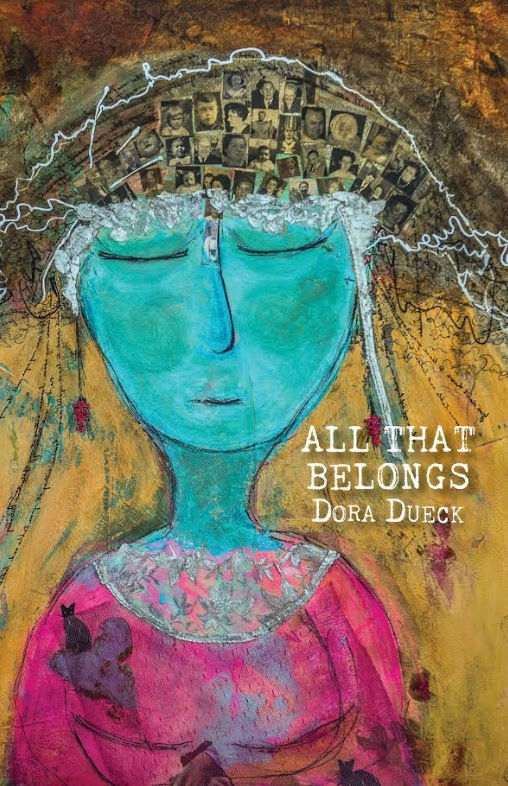 An email with “cover” in the subject line arrived. Breath held (what if I hate it?) as I opened it. Oh my! Wonderful! (The cover art, titled “Gertrude” is by Agatha Fast).
Whew on the cover then. It runs the emotional gamut, this year of bringing out a book. (Almost as if I were the adolescent!) And later, seeing who’d blurbed the book and my happiness about that. (Writers I admire: Sue Sorensen, Betty Jane Hegerat, K.D. Miller.)
Next, proofreading the set novel. They proofread, I proofread. I read each word aloud so my eye wouldn’t simply supply what it knew should be there. Since text looks different when set for publication, I noticed a few small changes I still wished to make. These were allowed. Emphasis on small. No re-writing now.
Even with all the proofreading, there may be things that slipped through; who knows? I just finished a book, one of the Giller long-listed books, in fact, and caught two typos. Yes, it happens. One hopes for perfect but lives with good enough.
I signed off, Turnstone signed off, the book has gone to the printers.
The final acts await. I’ll be launching the novel, first in Winnipeg (October 5). My husband and I plan to take a road trip to Manitoba for that event, with a number of possible other stops. Then I’ll do some launch events here in B.C. This stage feels fraught and vulnerable — will anyone show? How will the book be received? I do enjoy reading events and am always grateful for supportive friends and readers. And perhaps there will be some book club invitations. (I heard recently of an author attending one via Skype!) Which reminds me that I’m supposed to write some questions for book clubs.
So, still lots ahead until All That Belongs is truly on its own and I can put a copy on my bookshelf and let it be. And kind of forget about it. Yes, one does that too.
Before that, though, I’ll let you know about the road trip and launches and some of my other off-you-go experiences with All That Belongs!
(P.S. For a description and information about the book itself, please see the page devoted to it.)




 Becoming (2018) by Michelle Obama. I don’t know if it’s the trajectory of her life from Chicago’s South Side to the White House or her honest and passionate way of speaking or the brave self-awareness that opens towards growth – to “becoming” – or the current political situation which feels so different, or all of the above, but I was deeply moved by this book. To the point of tears at times. Moved and inspired to keep on becoming myself and making the world better where I can.
 Motherhood (2018) by Sheila Heti. Like some reviewers, I found this Giller-shortlisted “autofiction” odd and self-indulgent at first. It doesn’t have much of a plot; the narrator records, from this angle and that, her struggle whether to have a child. But, like the even more obsessive Karl Ove Knausgaard’s work, it was strangely compelling (though I refuse to give Knausgaard more than one book’s worth of space in my head) so I persevered and was rewarded in the end with intense probing of an important question, regardless of what decision is made, and then both movement and readerly satisfaction as the theme faces the narrator’s own mother. Perhaps this read also lingers with me because Heti uses the Genesis story of Jacob wrestling with the angel and I happened to be reading, at the same time, The Angel of the Left Bank by Jean-Paul Kauffman about the Delacroix painting “Jacob Wrestling with the Angel” in Paris. Both books reminded me that what we wrestle with changes us, humbles us like a limp.
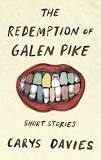 The Redemption of Galen Pike (2014) by Carys Davies. These are wonderful stories, quite short, and successful at a quality Susan Sontag described this way: “Every fictional plot contains hints and traces of the stories it has excluded or resisted in order to assume its present shape. Alternatives to the plot ought to be felt up to the last moment.” Suspense, in other words, of the very best kind. And though the point of stories is not the extraction of moralisms such as “appearances are deceiving”, I think that we do in fact read to remember that there’s often more at play than we suppose or see. Davies’ recent novel West is also good, also short (on some reading days that’s a huge virtue), but if you want to sample Davies I suggest beginning with the stories.
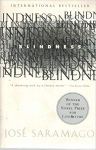 Blindness. This 1995 novel by Portuguese novelist and Nobel winner Jose Saramago grips as narrative, and also by its various possibilities as parable, including these lines about a blind writer’s words in ballpoint,“inscribed on the whiteness of the page, recorded in blindness, I am only passing through, the writer had said, and these were the signs he had left in passing.” Then, since I was immersed in this during our spring visit to family in Paraguay (I never travel without a book), an awful juxtaposition of text and life: our niece, a young grandmother, was led to us at a gathering, recently and mysteriously become blind. (Last we’ve heard, surgery didn’t work and she hasn’t yet recovered her sight).
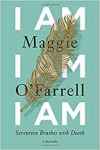 I am, I am, I am: Seventeen Brushes with Death (2018) by Maggie O’Farrell. That’s a lot of close calls. One of them made my skin crawl. But in their sum this memoir provokes gratitude for the mystery of life – hers, and mine – and compassion. Plus she’s a very good writer.
 Borrowing Bones